History
The name “Ásatrú” (“Æsir-belief”) isn’t older than about the 1970s, and the term “Forn Siðr” (“the old ways”) is from the time Christianity was introduced in Scandinavia, and the need to differentiate arose (around year 700).
Before that, the belief in the Æsir, Vanir, Vetr, etc. didn’t have a name.
How long it has been around, and how it developed over time, we don’t have the faintest clue.
Neither do we know how beliefs and rituals differentiated from one area to the next.
Unlike societies in the southern part of Europe, people didn’t write in Scandinavia until early medieval times.
Around 1200 some people started describing the faith and the stories associated with the faith, but they were Christians, and they tried to create some kind of coherent consistency from a vast number of fragments, from different local traditions – while keeping the Christian clergy calm.
From about 1400 to 1700 nobody dared mention a pre-Christian faith.
That, however, didn’t mean that Ásatrú disappeared. The old faith and myths simply blended with Christian mythology, to form the modern Norse folklore.
People would still celebrate Jól and talk about Nisser, Trolls, Vetr, Thor, Odin, Freyja, Valhal, Bifrost, etc., and many customs in the Nordic countries have a clear and unmistakable heathen origin.
The Danish national anthem doesn’t mention Jesus or God, but claims that Denmark is Freyja’s Hall.
About the same time the national anthem was composed, the interest for the pre-Christian period came back to life, and in 1873 a book was published with the title “The Dane’s Culture in the Viking Age”, and thus the term “Viking Age” was invented, and the word “Viking” became popular.
After the age of enlightenment and the unimaginable suffering during the two world wars Christianity started fading out.
In the 1970s people started thinking outside the box, especially in regards to philosophy and religious beliefs. In the Nordic countries (Iceland in particular) the interest for the non-Christian part of the folklore landed in the spotlight, and neo-paganism became a subject that attracted a lot of people.
The most significant event in the modern history of Ásatrú was the founding of Ásatrúarfélagið (the Ásatrú Fellowship) in Iceland in 1972 by farmer and poet Sveinbjörn Beinteinsson and a group of twelve others. This organization was officially recognized as a religious body by the Icelandic government in 1973, which gave it the legal right to perform ceremonies and collect a share of the church tax. Iceland’s Ásatrúarfélagið has grown steadily and is now the largest non-Christian religion in the country. The Icelandic movement is notable for its non-political, purely religious focus.
There is no single, central authority or dogma in Ásatrú. The religion is practiced through a variety of national organizations, regional gatherings, local groups, and by lone practitioners.
Modern practitioners rely on surviving historical sources to reconstruct and reinterpret the ancient religion. These sources include Old Norse texts like the Prose Edda and Poetic Edda, as well as archaeological evidence and folklore. However, since these sources were often written down by Christians and are fragmented, modern practitioners often have to create their own interpretations.
This is not a problem, though, as Ásatrú is not supposed to be universally streamlined and squeezing the followers into a box of a specific size and shape.
While there is no fixed dogma, some common elements of modern Ásatrú include:
- Polytheism: The worship of a pantheon of gods and goddesses, primarily the Æsir and Vanir, such as Odin, Thor, Freya, and Frigg.
- Blót: A central ritual of offering and sacrifice, often involving libations of alcohol (like mead or ale) to the gods, goddesses, and land spirits (Vettr).
- Emphasis on Deeds: A core belief is that one’s actions in this life are of primary importance (“we are our deeds”). There is less focus on a specific afterlife and more on living a virtuous and honorable life.
- Community and Ancestors: Many followers place a high value on community, family, and the veneration of ancestors.
In summary, modern Ásatrú is a young religion with a clear origin in the 1970s. It’s a diverse and decentralized movement, characterized by a commitment to reviving ancient traditions while also navigating contemporary issues.
The Dark Chapter
At the beginning of the 20th century, at the same time as interest in the Iron Age was experiencing a boom, many countries experienced a nationalist wave. Interest in Germanic and Scandinavian pre-Christian religions was mixed with völkisch (“folk” ethnocentric) movements.
With a keen sense for effective falsification of history, certain groups claimed that Germanics (and thus Scandinavians) were “ethnically pure”. The concept is known as “Nordicism”.
From its very beginning, some groups within Nazism was closely intertwined with a carefully revised reinterpretation of the Norse gods.
Many of these groups disappeared after World War II, due to the close connection with Nazism.
The connection still exists in very small closed groups in Northern Europe, and to a greater extent in the United States, where large parts of the country are ideologically comparable to 1930s Germany and Austria.
The generally recognized Ásatrú assemblies strongly distance themselves from the neo-Nazi falsification of history, but otherwise doesn’t interfere in the political positions of its members.
Modern DNA studies clearly show how complex the population was in Scandinavia, in the Iron Age and early Middle Ages, and against this background, many Nordicist movements have rejected DNA science as a “Jewish conspiracy”.
In the USA you can find the Nordicist groups Troth, AFA and AA, and in Norway there is the neo-Nazi incel (“involuntary celibate”, misogynistic) group fornsidr-dot-com.
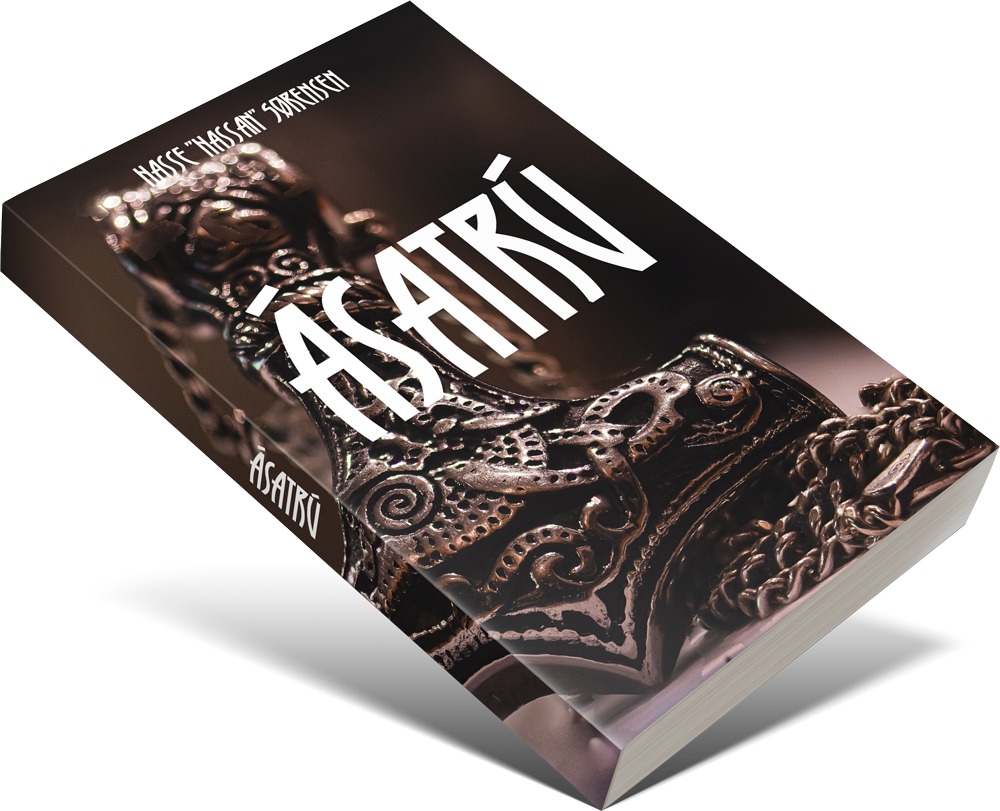
If you want to know everything about Æsir, Vanir, Jǫtun, Trǫll, Álfar, Svartálfar, Nisser, Véttr, Valkyrja, Dreki, Ormr, Fylgja, Disir, Yggdrasil, Ásgarðr, Midgarðr, Jǫtunnheimr, Múspellsheimr, Fólkvangr, Valhǫll, Gimli, runes, stories, poetry and sources, you can read the book “Ásatrú”.
232 pages • 12 x 19 cm
Paperback: DKK 149 • Ebook: DKK 65