The Æsir
Æsir is the plural or gender-neutral description of the Ása (male) and Asynja (female).
Here follows a description of the most well-known.
Óðinn is the creator and king of the Æsir. Also known by a vast number of pseudonyms, like “the One-Eyed”, “the Tall One”, “the Wise” and “the Allfather”. Óðinn lives in Ásgarðr, where he has the great hall Valhǫll (the hall of the slain). Along with his brothers, Vili and Vé, he killed the primordial being, Ymir, and from the corpse created the world and all living beings, including the first humans, Ask and Embla. In some traditions Óðinn is married to Frigg, in other traditions to Freyja. With his wife he has the son Baldr. With other women he has several other children, including Þórr, born by Jǫrð. Óðinn is known for his relentless pursuit of wisdom. In some traditions he has sacrificed one of his eyes to the well of wisdom, Mímisbrunnr, to get a drink from it, in other traditions he left his eye in the well as a remote way to see the wisdom at all times.
He has two ravens, Huginn and Muninn (“Thought” and “Memory”), and two wolves, Geri and Freki (“Greedy” and “Naughty”).
Wednesday is named after Óðinn (Wōden).
Freyja means “The Lady”, and she is associated with magic (Seiðr), love and sex. She is – however – also associated with war and death, as she rules over the Valkyrja, a group of female beings that will select the bravest of the slain warriors in a battlefield and escort them to Ásgarðr. Here Freyja will choose the best half of them for her land, Fólkvangr, and send the second half to Óðinn’s hall, Valhǫll. In Fólkvangr, Freyja’s estate in Ásgarðr, we find her great hall Sessrúmnir (“Seating Roomˮ). Freyja’s most prized possession is the necklace Brísingamen. The necklace has magic properties, and whatever your preferences are, the magic will make Freyja the most attractive woman you have ever seen.
Friday is named after Freyja.
As the son of Óðinn and Jǫrð (literally: “Earth”) Þórr (Thor) is the protector of Midgarðr – the human world. Þórr is the husband of the golden-haired Ásynja Sif and the lover of the Jǫtunn Járnsaxa. Þórr’s most prized possession is his famous war hammer Mjölnír, that he will throw, never to miss its mark, whereafter it will return to his hand. He mainly use it to kill Jǫtunn. Thunder is named after Þórr. Thursday is named after Þórr.
Loki is the most interesting of all the supernatural characters. He is the one who sets things in motion, and his shenanigans are a vital part of almost every story. He is also known as “the trickster”.
He is a skilled shape shifter, and also known to change gender quite frequently. By the Jǫtunn Angrboða, Loki is the father of Hel, the giant wolf Fenrisúlfr and the world serpent Jǫrmungandr. In the form of a mare, Loki was impregnated by the stallion Svaðilfari and gave birth to Óðinn’s eight-legged horse Sleipnir.
Freyr is the Vanir most often associated with fertility, pregnancy and harvest. In some cases described as a male manifestation of Freyja, in other cases described as her twin brother, to whom he was married when they arrived in Ásgarðr as prisoners of war/hostages, after the great war between the Æsir and Vanir. They were, however, forcibly divorced, as marriage between sister and brother is not allowed in Ásgarðr. The Æsir gave him Álfheimr, the realm of the Álfar (Elves), as a present.
The Vanir Njǫrðr lost his sister-wife in the great war between the Æsir and the Vanir. At the end of the war he and his twin children, Freyja and Freyr, were sent to Ásgarðr as prisoners of war or permanent hostages, to safeguard the peace. Njǫrðr lives in Nóatún, in Ásgarðr, and is associated with the sea, seafaring, wind, fishing, wealth, and crop fertility. Njǫrðr was in an ill-fated marriage with the Jǫtunn Skaði, who thrives in the mountains, where she is hunting with bow and arrow, while Njǫrðr is thriving by the sea. They tried living one period by the sea, and one period in the mountains, but none of them could stand living in the other one’s environment. For that reason they were divorced. Njǫrðr is therefore one of the Vanir you will blót to, if you are going through a divorce, to smooth things over. As a woman, you might choose Skaði.
Týr is son of Óðinn and the main Ása for war, and the T rune (ᛏ) is often associated with warfare.
Týr is recognised by the missing arm, as he sacrificed his arm in an effort to chain the Fenrisúlfr. Týr has given name to Tuesday.
The daughter of Loki and the Jǫtunn Angrboða, Hel was given the task of ruling over Helheimr, the frozen world of the dead (perhaps inside Niflheim). She loves nature and beauty, but everything dies when she gets close. Unlike her sibling – Jǫrmungandr and Fenrisúlfr – Hel is not a giant monster, but actually a pretty girl. She’s just very very goth… Her name and the name of her realm – Helheimr – is often confused.
Helheimr is not a hell or a punishment, but more like a kind of cryonic preservation of the soul.
The Nornir are the three oldest female beings in the world, Urðr (past), Verðandi (present) and Skuld (future), who weave the threads of fate and tend to the world tree, Yggdrasil. The length of a thread represents the length of a life, and still to this day, at a funeral in Scandinavia, you can hear someone saying “his thread was only this long”. When threads are crossed, it means people meet. If they form a knot it means people have a deeper connection.
Forseti (Old Norse ”the presiding one”, ”president” in modern Icelandic and Faroese) is the Ása of justice and reconciliation in Norse mythology. His is the best of courts; all those who come before him leave reconciled. Obviously associated with diplomacy.
Heimdall watches for attackers and the arrival of Ragnarǫk from his dwelling Himinbjörg, where the fiery rainbow bridge Bifrǫst ends. When Ragnarǫk begins, Heimdall blows the resounding horn Gjallarhorn.
Lofn is the Ásynja associated with infidelity. “She is so gentle and so good to invoke that she has permission from All-Father or Frigg to arrange unions between men and women, even if earlier offers have been received and unions have been banned.” In a world of arranged marriages blóting to this Ásynja could get you laid with the one you love. A shitty job, but somebody has to do it.
Syn is the Ásynja associated with defensive refusal. Maybe she is the origin of the famous Norse passive aggressiveness.
Skaði is a very attractive Jǫtunn, praised as the most skilled skier and archer. Briefly in an unhappy marriage to the Vanir Njǫrðr, whom she married as a compensation after her father Þjazi was killed. Maybe the origin of the Norse words “skade”, “skada” and “skaði” that translates to damage. Women would blót to Skaði to recover after a divorce (men to Njǫrðr). Some scholars argue that both the south Swedish region Skåne (“Scania” in English) and all of Scandinavia (“Dangerous Island”) is named after Skaði. Possibly by Romans, who used the native name to describe the mercilessly insane Scandinavians.
Rán is quite a shady character. An Ásynja that is both associated with the sea and raids. The Old Norse common noun rán means “plundering”, “theft” or “robbery”. The Vikings have probably given thanks to her after raiding the Lindisfarne monastery (insert evil laughter at your own discretion).
Járnsaxa is a female Jǫtunn and Þórr’s mistress. The name Járnsaxa means “Iron Dagger” or “Iron Sword” – a pretty name for a pretty girl. (I’d probably think twice before asking someone named “Iron Dagger” to make me a sandwich; that’s a subtle nod to healthy feminism, wouldn’t you say?)
With Loki as the father, the Jǫtunn Angrboða is the mother of three serious misfits: Hel, Fenrisúlfr and the world serpent Jǫrmungandr. The Old Norse name Angrboða has been translated as “the one who brings grief”. In Old Norse Angr means “regrets”, while in Modern English it has become the word “anger”.
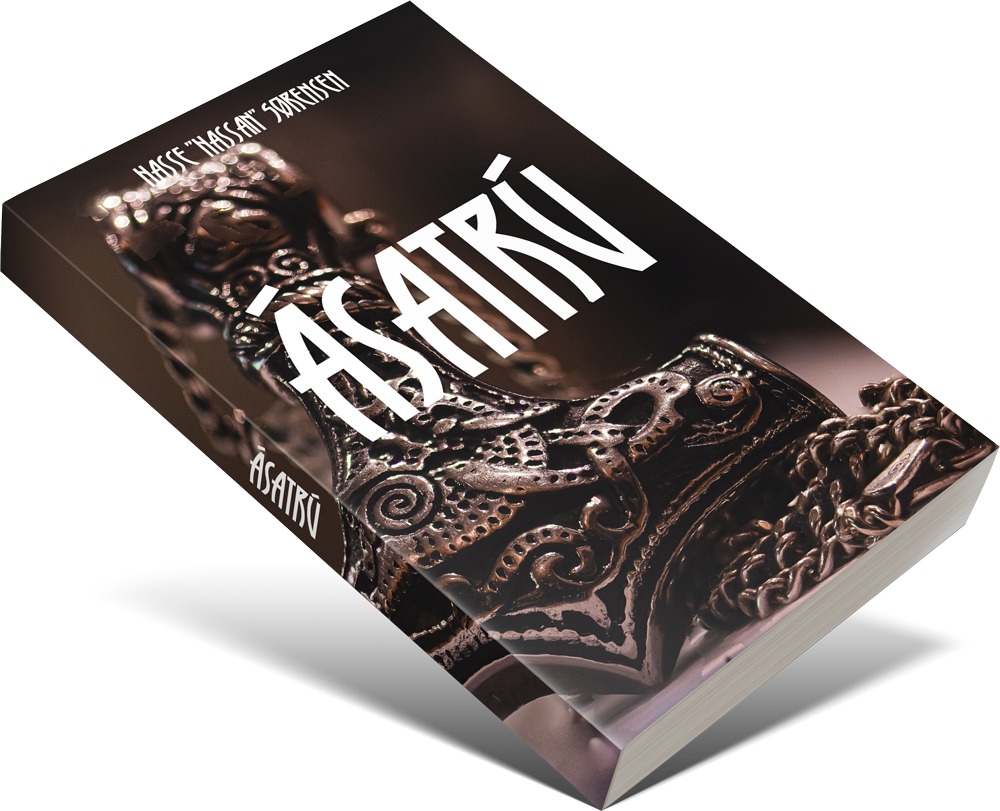
If you want to know everything about Æsir, Vanir, Jǫtun, Trǫll, Álfar, Svartálfar, Nisser, Véttr, Valkyrja, Dreki, Ormr, Fylgja, Disir, Yggdrasil, Ásgarðr, Midgarðr, Jǫtunnheimr, Múspellsheimr, Fólkvangr, Valhǫll, Gimli, runes, stories, poetry and sources, you can read the book “Ásatrú”.
232 pages • 12 x 19 cm
Paperback: DKK 149 • Ebook: DKK 65